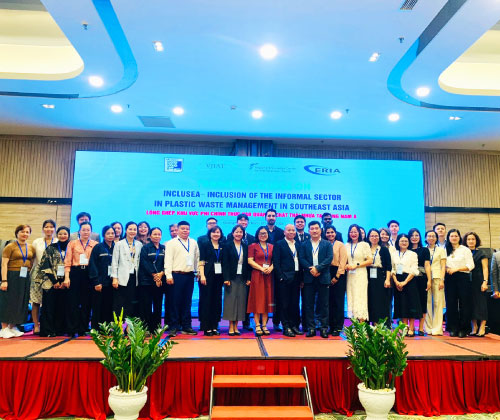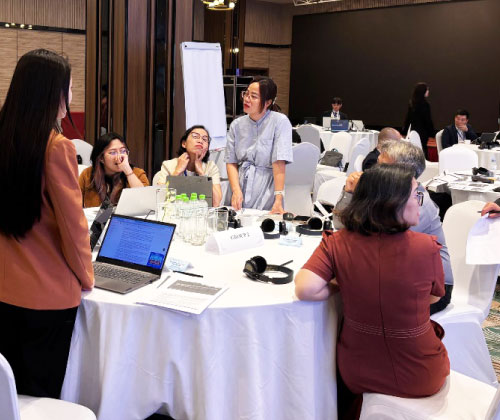
The training workshop on “INCLUSEA – Inclusion of the Informal Sector in Plastic Waste Management in Southeast Asia” was held on 27 March 2026 in Ha Long City, Vietnam. The workshop was organised by the Economic Research Institute for ASEAN and East Asia (ERIA) under the Regional Knowledge Centre for Marine Plastic Debris (RKC-MPD), with technical contributions from the Institute for Global Environmental Strategies (IGES) and the Asian Institute of Technology, Thailand.
The event brought together 22 participants from government institutions, academia, private-sector organisations, women-led community organisations, informal-sector actors and unions, grassroots NGOs, and local experts who work closely with informal waste workers to strengthen capacity for inclusive and sustainable plastic waste management systems. The training focused on Extended Producer Responsibility (EPR), circular economy approaches, and practical strategies to integrate informal waste workers into formal waste management systems.
Key Takeaways
The workshop highlighted several important insights:
- ● The informal sector is essential to the effectiveness of recycling systems and must be formally recognized and integrated into EPR frameworks
- ● Inclusive EPR systems can deliver environmental, economic, and social benefits when properly designed
- ● Stakeholder coordination and inclusive governance are critical for successful implementation
- ● Practical tools, including financial incentives and digital tracking systems, are necessary to operationalize integration
- ● A balanced approach is required to align regulatory objectives with economic feasibility and social inclusion
Background
Southeast Asia is experiencing rapid urbanisation and economic growth, leading to increased consumption and waste generation. Traditional linear economic models characterised by “take, make, dispose” are placing significant pressure on already-strained municipal waste management systems. Many countries in the region are among the largest contributors to marine plastic pollution, highlighting the urgent need for systemic change.
EPR is a key policy instrument for addressing these challenges by sharing responsibility for waste management with producers. By internalising the cost of waste management, EPR encourages sustainable product design and supports the development of recycling systems.
However, in many developing economies, the effectiveness of EPR depends heavily on the integration of the informal waste sector. Informal waste workers play a critical role in material recovery, often collecting and recycling a significant share of plastic waste. Despite their contribution, they remain largely unrecognised, facing economic vulnerability and limited access to formal systems. Ensuring their inclusion is essential to achieving both environmental outcomes and a just transition.
Against this backdrop, the INCLUSEA training workshop was conducted to provide a platform for stakeholders to better understand EPR systems, explore inclusive approaches, and develop practical strategies for integrating the informal sector into waste management frameworks.
Intent
- ● Enhance understanding of waste management systems, including the role of sorting and recycling in mitigating plastic pollution and contributing to a more sustainable circular economy.
- ● Raise awareness of the environmental and health impacts, promoting practical knowledge on occupational safety, hygiene and strategies to prevent hazards, violence, and harassment, particularly for women, youth, and other vulnerable groups.
- ● Empower the role of participants, facilitators, and local experts supporting the informal sector, while exploring risks and opportunities for their integration into inclusive EPR schemes and formal waste systems. Key insights from the informal sector will be consolidated into a policy brief to inform and support the inclusion of their perspective in policy development.
Summary
The training workshop was structured as an interactive, practice-oriented session combining lectures, group activities, and facilitated discussions.
One of the key components of the training was Session 3, “Empowering Informal Sector Integration – From Policy to Practice,” facilitated by IGES experts. The session focused on translating policy frameworks into actionable strategies for integrating informal waste workers into EPR systems. The session consisted of the following key topics.
- ● Introduction to INCLUSEA and EPR
- ● Emerging and updated regulatory framework and stakeholders
- ● Risks and opportunities of inclusive EPR & integrated solid waste management
- ● Strategies to integrate the informal sector into EPR systems
The session began with an overview of Southeast Asia’s waste challenges, the fundamentals of EPR, and its implementation across ASEAN countries. Participants were introduced to the concept of the informal sector as the backbone of recycling systems, highlighting their critical contribution to material recovery.
An interactive icebreaker activity encouraged participants to define EPR in their own words, revealing a shared understanding of EPR as both a policy tool and a system linking environmental protection, economic incentives, and social inclusion.
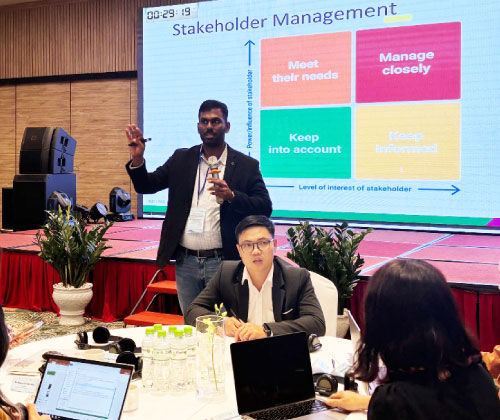
The session then explored the evolving regulatory landscape and stakeholder dynamics within EPR systems. Through a stakeholder mapping exercise, participants identified key actors and analysed their levels of influence and interest. This activity revealed significant power imbalances, with informal waste workers having high interest but limited influence, underscoring the need for inclusive governance mechanisms.
Participants further examined the risks and opportunities associated with inclusive EPR systems. Discussions highlighted environmental benefits such as increased recycling rates and reduced waste leakage, alongside social and economic benefits, including improved livelihoods and income stability for informal workers. At the same time, participants identified key challenges such as limited traceability, increased operational costs, and the risk of excluding informal actors during formalization processes.
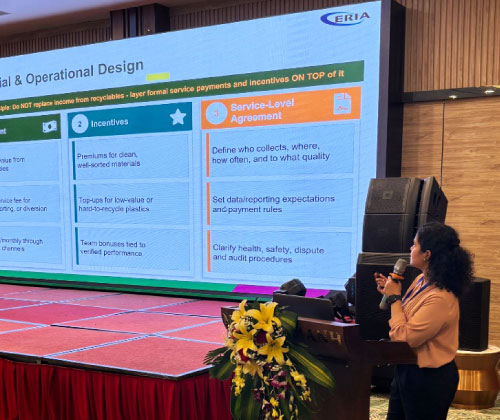
The final segment focused on practical strategies for integrating the informal sector into EPR systems. These included strengthening supply chain linkages, developing financial and incentive mechanisms, utilizing digital tools for tracking and monitoring, and promoting cooperative models.
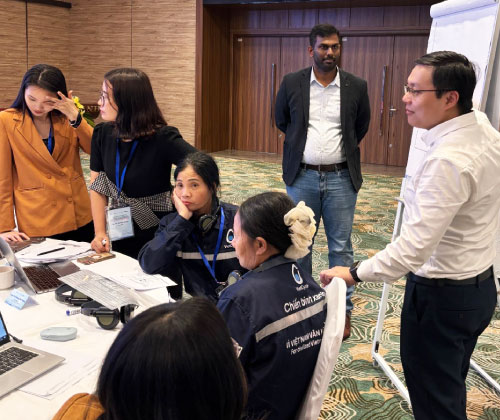
A role-play exercise allowed participants to simulate real-world stakeholder perspectives. Participants representing private sector actors emphasized compliance requirements, cost implications, and the need for efficient and traceable systems. In contrast, those representing government institutions focused on policy development, regulatory enforcement, and the provision of incentives to support inclusive systems. The exercise highlighted the importance of coordination and collaboration between stakeholders to achieve balanced and effective EPR implementation.