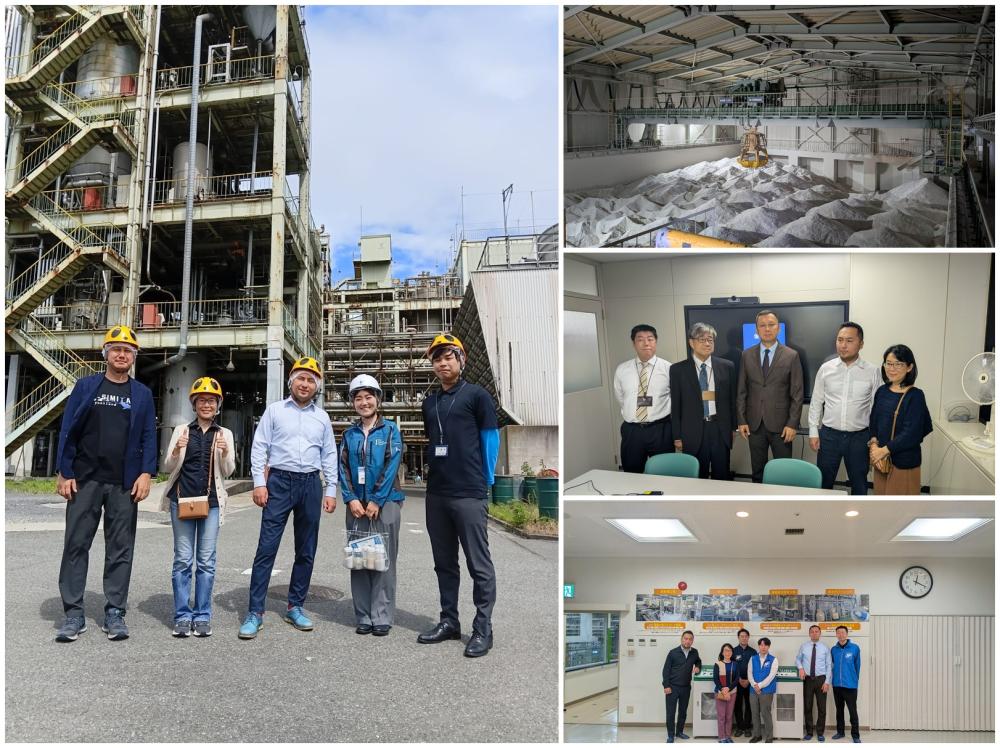
From 8 to 11 September 2026, CCET hosted a delegation from the Republic of Kazakhstan, made up of government and industry representatives, for a study visit in Tokyo and the Kanto region. Kazakhstan is enhancing the waste management sector and considering joint recycling facilities with Japanese partners. The visit was designed so the delegation could see how Japan's recycling system works as a whole: collection design, extended producer responsibility (EPR), digital traceability, and the construction and operation of treatment and recycling plants.
On the first day, after a briefing at the IGES Tokyo Office, the delegation met online with three companies. Kinsei Sangyo presented its pyrolysis gasification technology for industrial and medical waste. Nishihara Shoji explained how it integrates collection, recycling and incineration. Kyoei Steel introduced its method of treating medical and industrial waste in electric arc furnaces used for steelmaking. The delegation then visited Kawasaki Eco-Town, Japan's first certified eco-town, to learn how pollution control grew into industrial symbiosis. There they toured the PET Refine Technology (JEPLAN) plant, which chemically recycles used PET bottles back into bottles. JFE Engineering later presented its waste-to-energy plants and its model of both building and operating facilities.
At the Japan Containers and Packaging Recycling Association, the delegation learned how Japan's packaging EPR system is financed and operated. Kajima Environment Engineering demonstrated an electronic manifest system with blockchain-based traceability, and Kanadevia Corporation introduced its overseas project with waste-to-energy facility. The last site was FP Corporation's Kanto Recycling Plant in Yachiyo, Ibaraki, where the delegation saw its "Tray to Tray" horizontal recycling of food trays. The programme closed with a courtesy visit to the Embassy of the Republic of Kazakhstan in Tokyo.
Throughout the visit, the delegation expressed strong interest in fostering long-term partnerships with Japanese institutions and companies. Building on the knowledge, technologies, and experiences shared during the programme, Kazakhstan is planning to organize a regional workshop, "Towards a Circular Economy in Central Asia: Strengthening EPR Systems, Recycling Infrastructure and Business Partnerships," on 29 October 2026 in Astana. The workshop will bring together policymakers, industry representatives, recycling companies, and development partners to discuss practical approaches for strengthening Extended Producer Responsibility (EPR) systems, accelerating investment in recycling infrastructure, and promoting public-private partnerships across Central Asia. Japanese policy experiences, technologies, and business models will be highlighted to facilitate dialogue and identify opportunities for future cooperation. CCET will continue to work closely with its counterparts in Kazakhstan and other regional stakeholders to support knowledge exchange, foster business partnerships, and advance the transition towards a circular economy in Central Asia.