Background
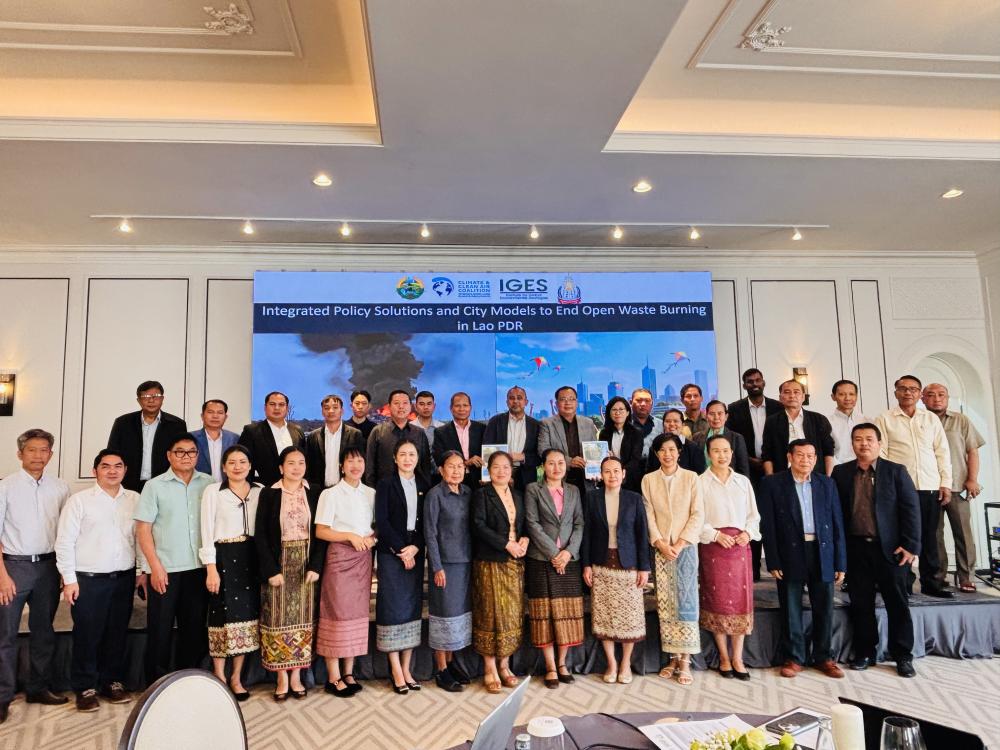
The final workshop on “Integrated Policy Solutions and City Models to End Open Waste Burning (OWB) in Lao PDR” was held on 18 December 2025 at the Souphattra Hotel in Vientiane Capital. This hybrid event served as a critical platform to disseminate the Regional Roadmap to End Open Burning of Waste for Asia and launch the Policy Recommendations Report for Lao PDR. The workshop was organised by the Institute for Global Environmental Strategies (IGES) Centre Collaborating with UNEP on Environmental Technologies (CCET) in collaboration with the Biotechnology and Ecology Institute of the Ministry of Agriculture and Environment (MAE) and the Climate and Clean Air Coalition (CCAC). It brought together national and regional stakeholders to discuss institutional pathways for integrating OWB reduction into national policies and air quality priorities across Asia.
Open Waste Burning (OWB) remains a dominant household disposal practice in Lao PDR, where national waste collection coverage is limited to approximately 34%. In peri-urban and rural areas, burning rates reach up to 75% due to the absence of viable collection alternatives. This practice emits toxic air pollutants, including PM2.5, black carbon (BC), dioxins, and furans which pose severe risks to public health and contribute to regional warming.
To address these challenges, the Regional Roadmap was developed based on assessments in 10 countries, sub-regional stakeholder consultations and city pilot activities in Lao PDR and the Maldives. The roadmap and the Lao-specific policy recommendations aim to provide actionable measures to eliminate OWB by improving waste infrastructure and strengthening institutional capacity.
Intent
The primary objective of this final workshop was to present a comprehensive policy framework for ending open burning in Lao PDR and the broader Asian region. Specifically, the session aimed to:
- • Present the Policy Recommendations Report for Lao PDR, which advocates for mainstreaming OWB prevention into existing national policies.
- • Disseminate the Regional Roadmap to End Open Burning of Waste for Asia, highlighting its relevance to regional air quality and climate goals.
- • Discuss policy and institutional pathways for translating these recommendations into national regulations and action plans.
- • Strengthen cross-sectoral coordination among government agencies, international partners, and village-level authorities.
- • Showcase city pilot models and lessons learned from regional successes in Cambodia, India, and the Philippines.
Summary
The workshop opened with remarks from Mr Sivixay Salivanh (Vientiane Capital), Dr Premakumara Jagath (IGES-CCET), and Ms Camille Tahon (UNEP-CCAC), focusing on the urgent need for integrated air-climate-waste solutions. Ms Miho Hayashi (IGES) and Ms Yujeong Kim (UNEP ROAP) provided a regional overview, emphasising that OWB reduction must be aligned with national air quality and climate commitments.
A central highlight was the official launch of the “Policy Recommendations Report on OWB for Lao PDR”. Mr Lakshitha Paranagamage (IGES) presented detailed recommendations, including prohibiting OWB in household regulations, improving dumpsite management, and ensuring legal mandates for the inclusion of women and vulnerable groups in waste governance.
The integration of policies at the national and local levels in Iraq and the Maldives was shared by Mr Rzgar Bewani and Ms Miho Hayashi, respectively, followed by a Q&A session. The Q&A session focused on the integration of policy recommendations into existing policies. The panel members were Ms Bounmany Soulideth, Deputy Director of the Biotechnology and Ecology Institute, MAE, Ms Souvanna Phengasisomboun, Head of the Natural Resources Management Unit, National University of Laos and Mr Rzgar Bewani (Iraq).
The afternoon session focused on practical implementation. Dr Champathong Phochanthilath presented the Vientiane City Pilot Model, followed by remarks from six village leaders on the success of recyclable waste collection strategies in their communities. Regional experiences were shared, including Ms Bopha (Cambodia), Mr Shibu KN (India), Mr Rap Villavicencio (Philippines), and Mr George Asiimwe, Senior Officer and Lead, Circular Economy Unit, GGGI who shared lessons from zero-waste and city pilot models, emphasising the role of community-based interventions and the informal sector.
An interactive panel discussion explored how to embed OWB recommendations into sub-national plans. The workshop concluded with a practical hand-over of air quality monitors to the pilot villages by Ms Bounmany Soulideth (MAE), signaling a commitment to data-driven monitoring of OWB incidents at the local level.