Recently, South Asian nations have taken a decisive step by adopting the Kathmandu Declaration, committing to end the harmful practice of open waste burning across the region. Open waste burning is a major contributor to air pollution and climate change, and it introduces harmful toxins into soil, water, and food chain. The declaration is one of the key outcomes of the Regional Roadmap on Transformative Action to End Open Burning of Waste in Asia, discussed at a regional meeting held in September 2025.
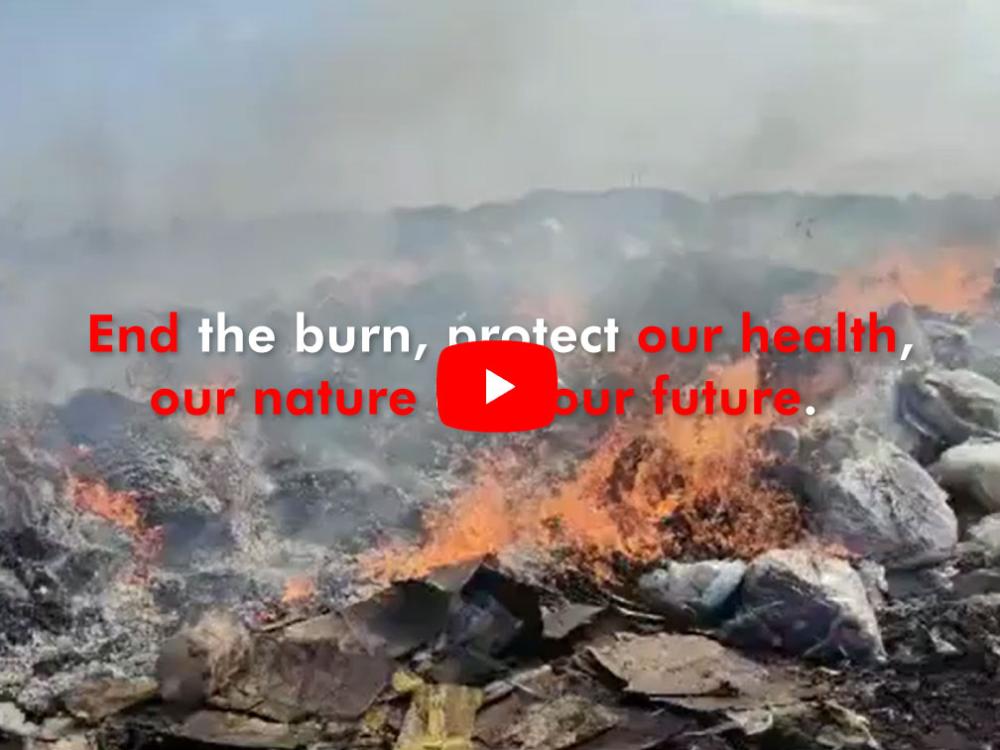
To support the goals of the Kathmandu Declaration and raise awareness, CCET has put together a short, five-part video series in partnership with the Administrative Staff College of India (ASCI)
- ・ Understanding OWB
- ・ The Causes of OWB
- ・ The Consequences of OWB
- ・ Those Most Affected by OWB
- ・ Taking Action Against OWB
Furthermore, in order to address the OWB issue, CCET developed the ‘Regional Roadmap to End Open Burning of Waste in Asia’ with the support of national government representatives, academia, private sector, NGOs and experts in the region under the global project ’Creating The Enabling Conditions For Eliminating Open Burning of Waste Through Regional Roadmaps and City Pilots’ supported by the Climate and Clean Air Coalition (CCAC), 2022-2026. The Regional Roadmap was officially launched at the Better Air Quality (BAQ) conference in 2026,11th-13th March 2026 at the UN Conference Centre (UNCC) in Bangkok.
For more details, see the publication: Regional Roadmap to End Open Burning of Waste in Asia or Regional Roadmap to End Open Burning of Waste in Asia | Climate & Clean Air Coalition
1. Local open burning of waste as a global climate issue
Every year, communities burn millions of tonnes of waste, releasing toxic pollutants into the atmosphere. This harmful habit endangers public health, damages the local environment, and accelerates global climate change. Explore our work toward a future free from open waste burning.
2. The cause of open burning
Globally, 40% of waste is openly burned due to underlying issues such as a lack of effective waste collection services, improper disposal site management, financial constraints, weak governance, and low awareness. People also burn e-waste to extract valuable material such as metal. While burning waste can be seen as a quick fix to get rid of garbage in front of us, the consequence is enormous. Air pollution and acceleration of climate change, posing threats to our health and on the earth.
3. Impact on health and local environment
Open waste burning releases toxic air pollutants and greenhouse gases (GHGs), including CO2, black carbon, methane dioxins, as well as hazardous metals, contributing to severe soil andwater contamination, and climate change. In other words, open waste burning is not just a waste issue. It is a practice affecting our health, air and planet.
4. Community Voices
Burning waste is an inescapable reality for workers in and around dumping sites. Under the toxic smoke, there is nothing they can do but breathe while working for a living, even though they are fully aware of the serious risks to their health. Many suffer from sleeplessness and persistent sore throats. This issue goes far beyond pollution—it is a human crisis, and one that is entirely preventable.
5. Solutions
Change is possible. Our current model of “we take, make, dispose” must evolve and waste should be seen as a resource, not a burden. This shift requires building capacity, decentralising action, raising awareness, and putting solutions into practice at the community level, supported by strong partnerships.